
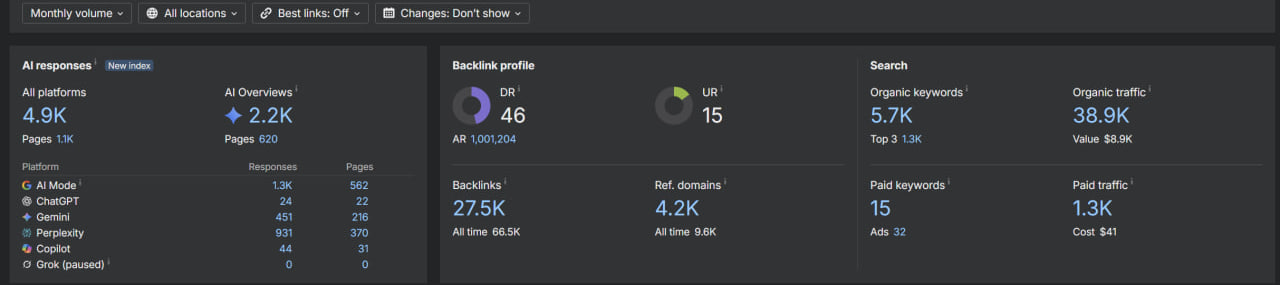
How do you boost brand visibility in AI search when your budget is microscopic? We spent $1 260 on 36 listicles and comparisons on niche websites. In 5 days, our client’s e-commerce project in Europe gained +55% mentions in Google AI Overviews
Initial data
- Niche: e-commerce
- Geo: Europe
- Goal: increase brand visibility in AI system answers (Google AI Overviews, AI Mode, ChatGPT, Gemini, Perplexity, Copilot)
Website status at the start
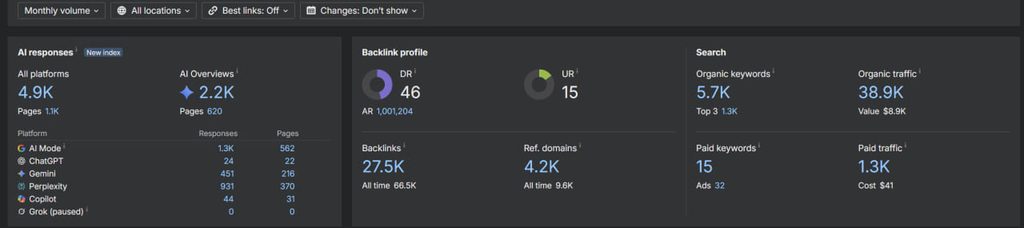
| Metric | Value |
| DR | 46 |
| Referring domains | 4.2K |
| Organic traffic | 38.9K / mo |
| Organic keywords | 5.7K (in TOP-3: 1.3K) |
| AI answers (all platforms) | 4.9K |
| AI Overviews | 2.2K answers / 620 pages |
In other words, classic SEO was already working for the project: it had traffic, rankings and a backlink profile. However, the brand appeared in AI results far less often than its weight in the niche would allow.
What had already been tried and why it didn’t work
1. Technical website optimization. The client’s specialists had taken the website as far as it could go: technical fixes, structure, high-quality on-page content. This had no effect on AI visibility.
2. External articles. They ordered high-quality publications on third-party resources. There were no noticeable changes either.
Conclusion: AI systems need independent third-party sources that compare options and explicitly name the brand among the best. A regular overview article about the brand doesn’t send that signal.
Solution
We at RankExplore bet on the format AI models are most willing to cite when answering queries like “what’s the best…”, “what to choose…”, “X vs Y”. That is, mass placement of listicle articles on niche domains
Formats:
- “TOP-X best…”
- comparisons of services and sellers in the niche
Content requirements:
- every claim is backed by facts, with no “fluff” or blatant advertising
- data tables comparing specific parameters
- structured lists that are easy to parse and cite
- the brand is ranked 1-2 in every ranking
Domain selection criteria:
- niche relevance only, and this is the main filter
- geo was not taken into account
- minimal technical metrics: presence of traffic, DR, no spam
We deliberately didn’t chase “heavyweight” donors. For AI, topical proximity and the comparison format matter more than domain authority in the classic sense.
Volume and budget
| Parameter | Value |
| Number of placements | 36 |
| Total budget | $1 260 |
| Average cost per placement | $35 |
Results after 5 days
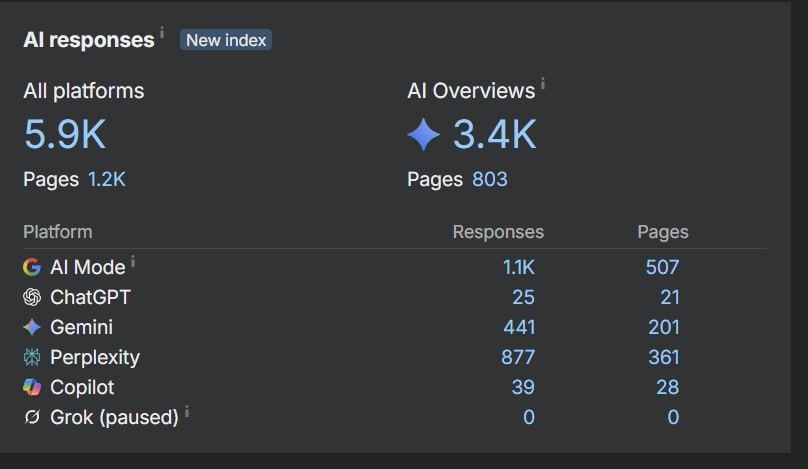
| Metric | Before | After 5 days | Change |
| AI answers, all platforms | 4.9K | 5.9K | +1.0K (+20%) |
| Pages in AI answers | 1.1K | 1.2K | +9% |
| Google AI Overviews, answers | 2.2K | 3.4K | +1.2K (+55%) |
| Google AI Overviews, pages | 620 | 803 | +183 (+30%) |
Most of the growth came from Google AI Overviews. Other platforms, such as AI Mode, Gemini, Perplexity, ChatGPT, Copilot, remain stable, within normal fluctuations.
10.10.26
15.10.26
Conclusions
- Technical SEO and on-site content are the foundation
- Regular external articles don’t always mean a signal for AI. The model looks for comparisons and rankings where the brand is explicitly named among the leaders.
- Format matters more than the donor’s DR. Listicles with tables and facts on niche websites with minimal metrics delivered results where more expensive approaches failed.
- Speed. The first changes are visible within just 5 days, so the hypothesis can be tested on a small budget.
If you’re interested in this area, write to us. Our specialists will consult you and offer the most optimal solution.
You can submit a request in your account – “Contact support”, or via messenger @nekitseo

Leave a Reply