
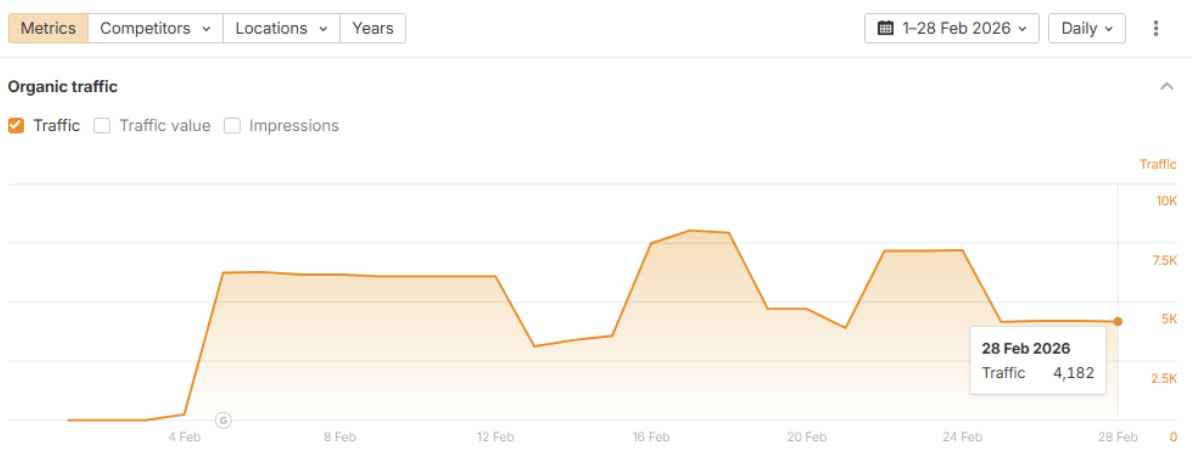
The problem: a cold project with no link history, no landing pages for semantics, and no visibility. The standard “grow gradually” approach didn’t work—the goal was to enter the top 3 in a month.
Starting conditions
- Traffic: 48 sessions per month
- Link profile: 0 domains
- Starting positions: High-frequency query 1 (HF-1) — 20th, HF-2 — outside the top 100
- Goal: Top 3 for the main HF in 30 days, Top 3–5 for the second HF
Strategy
- Site structure: Created landing pages for each HF cluster, set up internal linking taking into account the priority of acceptors.
- Content with geo-relevance: Texts were written for local search intent, not as a translation from an English template. The algorithm ranks “market-specific content” fundamentally differently from template-based content.
- Link pyramid Tier 1–3: All weight converges at a single point.
Link pyramid Tier 1–3
Tier 1: 1 expensive outreach
High-quality placement on a strong donor, pointing to the acceptor for the main HF. One, but expensive and very high quality. Saving money here nullifies the entire pyramid.
Tier 2 — 10 homepages
Homepages of high-quality sites in the relevant geo, all pointing to the Tier 1 outreach, turning it into a super-donor.
Tier 3 — 200 crowd links 20 for each homepage
They create a natural cushion and power up the links from the homepages. Without them, each link from a homepage is an average donor; with them, it passes 2–3 times more weight. Architecture: 211 links work as one concentrated signal, not as scattered dots.
Result
- Traffic: growth from zero to 5,000–8,000.
- Main HF positions: first two weeks — fluctuations 5–14 (the algorithm “doesn’t believe” the signal). Last 3 days — stable 3rd.
- Second HF — stable 6th with further entry into the top 3.
Both goals (main HF in TOP 3 in 30 days, second in TOP 3–5) were achieved. Stabilization. A month later, the positions didn’t “drift” but became consolidated.
Conclusion: 211 links in the right pyramid work stronger than 500 chaotic ones. The solution is not in quantity, but in architecture.

Leave a Reply